
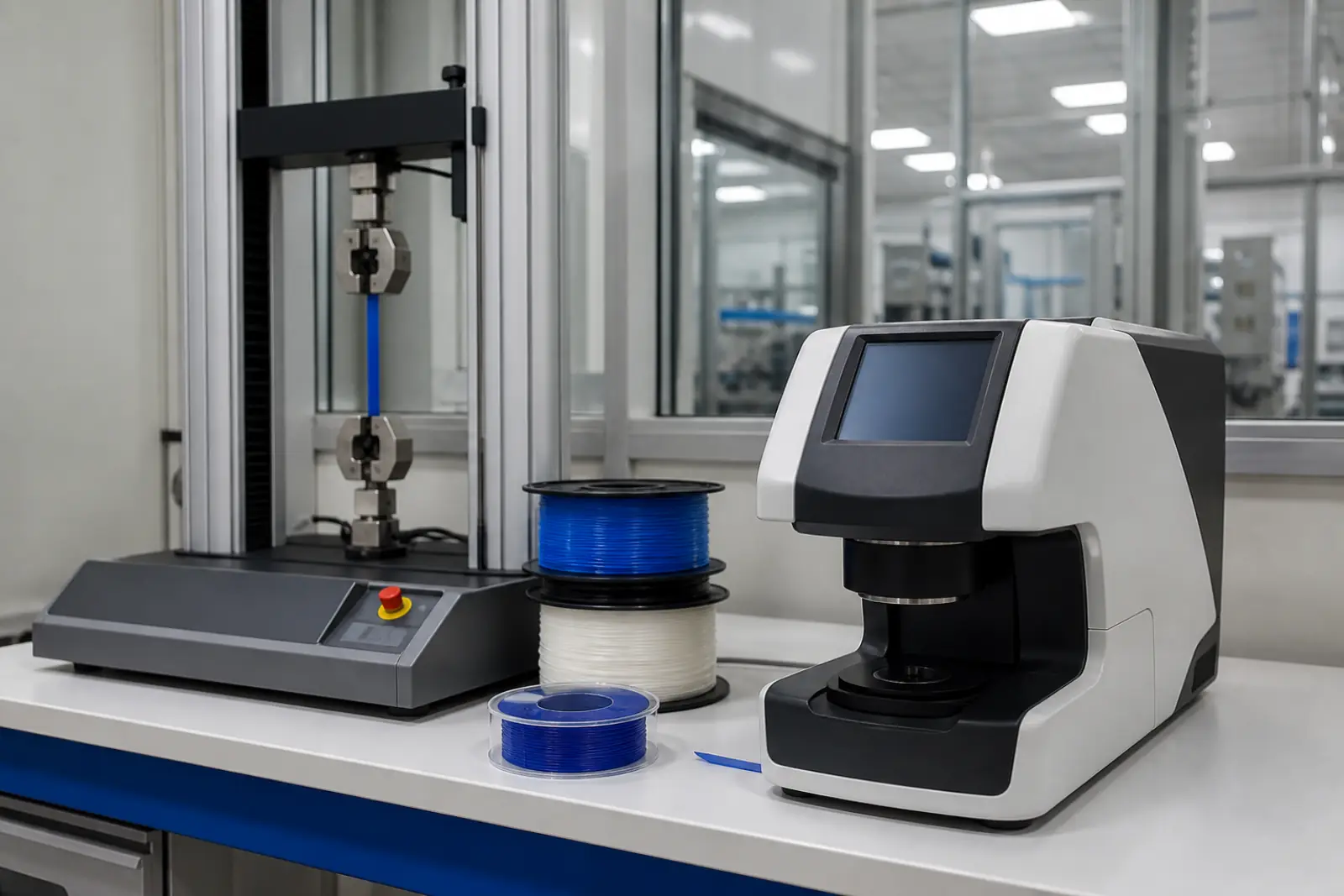
Printing Guide
Recommended bed and nozzle temperatures, print speed, enclosure, and cooling for each material family.
Quick Reference
| Material | Nozzle | Bed Temp | Fan | Speed | Enclosure |
|---|---|---|---|---|---|
| PLA | 200-220°C | 50-60°C | 100% | 40-60 mm/s | Optional |
| PVB | 200-220°C | 50-60°C | 100% | 40-60 mm/s | Optional |
| PETG | 230-250°C | 70-80°C | 30-50% | 30-50 mm/s | Recommended |
| TPU | 220-240°C | 45-60°C | 0-30% | 20-40 mm/s | Not needed |
| TPE | 220-240°C | 45-60°C | 0-30% | 20-40 mm/s | Not needed |
| TPC | 220-240°C | 45-60°C | 0-30% | 20-40 mm/s | Optional |
| ABS | 240-260°C | 90-110°C | 0-30% | 40-60 mm/s | Required |
| ASA | 240-260°C | 90-110°C | 0-30% | 40-60 mm/s | Required |
| PA | 250-280°C | 80-100°C | 0-30% | 30-50 mm/s | Required |
| PC | 275-300°C | 100-120°C | 0-30% | 30-50 mm/s | Required |
| CF | 220-300°C | 60-110°C | 0-30% | 30-50 mm/s | Required |
| GF | 240-280°C | 75-100°C | 0-30% | 30-50 mm/s | Required |
| Support | 200-240°C | 50-60°C | 100% | 40-60 mm/s | Optional |
| PEEK | 350-420°C | 120-140°C | 0-10% | 20-40 mm/s | Required |
| PEI | 350-420°C | 120-140°C | 0-10% | 20-40 mm/s | Required |
| PVDF | 350-420°C | 120-140°C | 0-30% | 20-40 mm/s | Required |
| PEKK | 350-420°C | 120-140°C | 0-10% | 20-40 mm/s | Required |
| PPSU | 350-420°C | 120-140°C | 0-10% | 20-40 mm/s | Required |
| PVA | 190-210°C | 50-60°C | 100% | 30-50 mm/s | Not required |
| Carbon Fiber | 240-270°C | 80-100°C | 50-100% | 30-60 mm/s | Recommended |
| Glass Fiber | 240-270°C | 80-100°C | 50-100% | 30-60 mm/s | Recommended |
| Specialty | 280-350°C | 100-140°C | Off | 20-50 mm/s | Required (high-temperature) |
Detailed Tips
PLA (Polylactic Acid)
Nozzle Temp: 200-220°C
Bed Temp: 50-60°C
Fan: 100%
Print Speed: 40-60 mm/s
Enclosure: Optional
- Dry at 50°C for 4h if moisture is high
- Use 100% fan for best detail
- Avoid retractions >5mm on Bowden
✓ Advantages
- Very easy to print, minimal warping
- High print quality and fine detail
- Low cost, excellent value
- Biodegradable and eco-friendly
- Wide range of colors available
- Low odor during printing
✕ Limitations
- Low heat resistance (softens above 55°C)
- Brittle, low impact strength
- Not suitable for outdoor use (UV degradation)
- Average chemical resistance
- Not for high-temperature functional parts
◆ Applications
- Prototyping and concept models
- Education and makerspaces
- Decorative items and art
- Toys and figurines
- Packaging and display stands
- Low-load jigs and fixtures
PVB
Nozzle Temp: 200-220°C
Bed Temp: 50-60°C
Fan: 100%
Print Speed: 40-60 mm/s
Enclosure: Optional
- Print at 190-220°C with 100% part cooling
- Alcohol vapour smoothing gives a glass-like finish
- Store sealed — PVB is sensitive to moisture
PETG (Engineering Grade)
Nozzle Temp: 230-250°C
Bed Temp: 70-80°C
Fan: 30-50%
Print Speed: 30-50 mm/s
Enclosure: Recommended
- Reduce fan to 30-50% for layer adhesion
- Keep nozzle >230°C
- Clean nozzle with cold pull after long runs
✓ Advantages
- High strength and toughness
- Excellent clarity (up to 90% light transmission)
- Great chemical and acid/alkali resistance
- Good weather resistance for outdoor use
- Food-contact suitability must be confirmed by grade, batch and documentation.
- Strong layer adhesion, low delamination risk
✕ Limitations
- Hygroscopic — must be dried before printing
- Prone to stringing, requires tuning
- Harder to sand and polish than PLA
- Moderate heat resistance (70-80°C)
- More expensive than PLA
◆ Applications
- Engineering functional and structural parts
- Transparent enclosures and guards
- Food packaging and containers
- Medical device housings
- Outdoor components
- Chemical equipment parts
TPU (Thermoplastic Polyurethane)
Nozzle Temp: 220-240°C
Bed Temp: 45-60°C
Fan: 0-30%
Print Speed: 20-40 mm/s
Enclosure: Not needed
- Disable retraction or set to 1mm
- Print at 20-40 mm/s
- Keep fan low for layer bonding
✓ Advantages
- High elasticity — bends and rebounds
- Excellent abrasion resistance
- Oil and chemical resistant
- High tear strength
- Good vibration damping
- Wide Shore hardness range (60A-95A)
✕ Limitations
- Slow print speed, low throughput
- Requires direct drive (Bowden is difficult)
- Extremely hygroscopic — must be dried
- Lower dimensional accuracy
- Prone to stringing and oozing
◆ Applications
- Seals and gaskets
- Phone cases and protective covers
- Footwear and insoles
- Shock-absorbing components
- Toys and wearables
- Industrial hoses and belts
TPE
Nozzle Temp: 220-240°C
Bed Temp: 45-60°C
Fan: 0-30%
Print Speed: 20-40 mm/s
Enclosure: Not needed
- Direct drive extruder strongly recommended
- Print at 20-40 mm/s with minimal retraction
- Dry at 50°C for 4h if the spool has absorbed moisture
TPC
Nozzle Temp: 220-240°C
Bed Temp: 45-60°C
Fan: 0-30%
Print Speed: 20-40 mm/s
Enclosure: Optional
- Direct drive and a high-flow hotend give the best results
- Print at 30-45 mm/s with low retraction
- Dry before printing — TPC absorbs moisture quickly
ABS (Acrylonitrile Butadiene Styrene)
Nozzle Temp: 240-260°C
Bed Temp: 90-110°C
Fan: 0-30%
Print Speed: 40-60 mm/s
Enclosure: Required
- Enclosure temp >40°C
- Fan off or very low
- Acetone smoothing for glossy finish
✓ Advantages
- High strength and impact resistance
- Good heat resistance (HDT ~95°C)
- Acetone smoothing for mirror finish
- Easy to glue — great for large assemblies
- Cost-effective and widely available
- Paintable and platable post-processing
✕ Limitations
- Emits fumes — ventilation required
- Prone to warping — needs heated bed + enclosure
- Relatively high shrinkage (0.5-0.8%)
- Layer strength sensitive to temperature
- Demanding on printing environment
◆ Applications
- Industrial functional and structural parts
- Automotive component prototypes
- Electrical housings and enclosures
- Jigs, fixtures, and tooling
- Building block style toys
- Models requiring polishing
ASA (Weather-Resistant)
Nozzle Temp: 240-260°C
Bed Temp: 90-110°C
Fan: 0-30%
Print Speed: 40-60 mm/s
Enclosure: Required
- Enclosure required
- No fan for best layer adhesion
- UV resistant, no yellowing
✓ Advantages
- Excellent weather and UV resistance
- Long-term outdoor use without fading/brittling
- High strength and toughness
- Good heat resistance (HDT ~95°C)
- Much less printing odor than ABS
- Good chemical resistance
✕ Limitations
- More expensive than ABS
- Still benefits from enclosure to reduce warping
- Relatively high shrinkage
- Smoothing less effective than ABS
◆ Applications
- Outdoor functional parts
- Automotive exterior prototypes
- Architectural models and components
- Sports equipment
- Garden tool housings
- Signage and displays
PA (Nylon)
Nozzle Temp: 250-280°C
Bed Temp: 80-100°C
Fan: 0-30%
Print Speed: 30-50 mm/s
Enclosure: Required
- Must be bone-dry before printing
- Enclosure required
- High toughness and wear resistance
✓ Advantages
- High strength, toughness, and excellent wear resistance
- Self-lubricating — great for gears and bearings
- Good oil and chemical resistance
- High impact strength
- Wide operating temperature range
- Can print thin flexible parts
✕ Limitations
- Extremely hygroscopic — thorough drying mandatory
- High shrinkage — dimensional accuracy challenging
- Requires high-temperature hot end (250°C+)
- Enclosure is a must
- Higher cost
- Layer strength temperature-sensitive
◆ Applications
- Industrial gears and bearings
- Jigs, fixtures, and tooling
- Automotive components
- Mechanical structural parts
- Hinges and living hinges
- Functional prototype validation
PC (Polycarbonate)
Nozzle Temp: 275-300°C
Bed Temp: 100-120°C
Fan: 0-30%
Print Speed: 30-50 mm/s
Enclosure: Required
- Heated chamber essential
- Slow print speed for layer bonding
- Use hardended nozzle
✓ Advantages
- High strength and impact — engineering-grade performance
- High transparency (near glass-like)
- Good heat resistance (HDT ~120°C)
- Excellent dimensional stability
- Superb electrical insulation
- Steam sterilizable (medical grade)
✕ Limitations
- High printing temperature requirement (260-300°C)
- Enclosure mandatory
- Hygroscopic — must be dried
- High internal stress — prone to cracking
- Higher cost
- Demanding on printer capability
◆ Applications
- Engineering structural and functional parts
- Transparent protective guards and face shields
- Electronics and electrical enclosures
- Automotive components
- Medical devices (medical-grade PC)
- Lighting and lamp components
CF
Nozzle Temp: 220-300°C
Bed Temp: 60-110°C
Fan: 0-30%
Print Speed: 30-50 mm/s
Enclosure: Required
- Use hardened steel or ruby nozzle
- Increase first layer temp +10°C
- Print slower for accuracy
GF
Nozzle Temp: 240-280°C
Bed Temp: 75-100°C
Fan: 0-30%
Print Speed: 30-50 mm/s
Enclosure: Required
- Hardened nozzle essential
- Good dimensional stability at elevated temp
- Enclosure recommended
Support
Nozzle Temp: 200-240°C
Bed Temp: 50-60°C
Fan: 100%
Print Speed: 40-60 mm/s
Enclosure: Optional
- Store in dry-box, very hygroscopic
- Disable retraction
- Dissolve in warm water 2-4h
PEEK
Nozzle Temp: 350-420°C
Bed Temp: 120-140°C
Fan: 0-10%
Print Speed: 20-40 mm/s
Enclosure: Required
- Heated chamber essential
- All-metal hotend required
- Anneal post-print for crystallinity
PEI
Nozzle Temp: 350-420°C
Bed Temp: 120-140°C
Fan: 0-10%
Print Speed: 20-40 mm/s
Enclosure: Required
- Nozzle 360-390°C, bed 120-140°C
- Dry at 120-150°C for 4-6h before printing
- All-metal hotend essential — no PTFE in the hot zone
PVDF
Nozzle Temp: 350-420°C
Bed Temp: 120-140°C
Fan: 0-30%
Print Speed: 20-40 mm/s
Enclosure: Required
- Nozzle 240-260°C, bed 80-100°C
- Use a corrosion-resistant all-metal hotend
- Good layer adhesion at moderate speed
PEKK
Nozzle Temp: 350-420°C
Bed Temp: 120-140°C
Fan: 0-10%
Print Speed: 20-40 mm/s
Enclosure: Required
- Heated chamber essential
- All-metal hotend required
- Anneal post-print for crystallinity
PPSU
Nozzle Temp: 350-420°C
Bed Temp: 120-140°C
Fan: 0-10%
Print Speed: 20-40 mm/s
Enclosure: Required
- Heated chamber essential
- All-metal hotend required
- Anneal post-print for crystallinity
PVA / BVOH (Soluble Support)
Nozzle Temp: 190-210°C
Bed Temp: 50-60°C
Fan: 100%
Print Speed: 30-50 mm/s
Enclosure: Not required
- For dual-extruder printers — supports for complex overhangs
- Extremely hygroscopic — must be stored sealed and dry
- Prints at low temp (190-210°C); pairs well with PLA
- Dissolves in warm water (40-60°C); agitation speeds it up
- PVA turns yellow when degraded — affects print quality
- BVOH dissolves faster — preferred option
- Minimize support contact area for best surface finish
✓ Advantages
- Water soluble — clean support removal
- Ideal for complex overhangs and cavities
- Excellent surface quality near support areas
- Good compatibility with PLA/PETG
- No part damage during removal
- BVOH dissolves faster than PVA
✕ Limitations
- Expensive
- Very hygroscopic — hard to store
- Requires dual-extruder printer
- Long dissolution time (hours to days)
- Slow printing speed
- PVA has shelf life — can degrade
◆ Applications
- Complex geometric supports
- Internal cavities and hollow structures
- High-quality surface finish models
- Jewelry and dental models
- Dual-extruder prototyping
- Art sculptures and complex forms
Carbon Fiber Reinforced
Nozzle Temp: 240-270°C
Bed Temp: 80-100°C
Fan: 50-100%
Print Speed: 30-60 mm/s
Enclosure: Recommended
- Carbon fiber filled — high stiffness, light weight
- Use hardened steel nozzle — CF is highly abrasive
- Print slower for better layer bonding
- Dry according to base material guidelines
- Matte surface finish with visible carbon fiber texture
- Wall thickness >1mm for best reinforcement effect
- Moderate retraction to reduce nozzle wear
✓ Advantages
- Exceptional strength and stiffness
- Lightweight (lighter than aluminum)
- Excellent dimensional stability, low shrinkage
- Good chemical resistance
- Premium matte surface finish
- Better heat resistance than base polymer
✕ Limitations
- Higher cost
- Rapid nozzle wear — needs hardened steel nozzle
- Relatively lower inter-layer strength
- More brittle than base material
- Textured surface — hard to polish
- Requires careful print tuning
◆ Applications
- Aerospace components
- Racing and drone structural parts
- Industrial jigs and fixtures
- Sports equipment
- High-performance functional parts
- Lightweight structural elements
Glass Fiber Reinforced
Nozzle Temp: 240-270°C
Bed Temp: 80-100°C
Fan: 50-100%
Print Speed: 30-60 mm/s
Enclosure: Recommended
- Glass fiber filled — high rigidity, dimensional stability
- Hardened steel nozzle recommended (glass is abrasive)
- Print hotter than base material for proper melting
- Dry according to base polymer requirements
- Don't print too fast — ensure layer bonding
- Semi-translucent / milky appearance with fiber texture
- Wall thickness >1mm for optimal strength
✓ Advantages
- High strength and rigidity
- Excellent dimensional stability
- Better heat resistance than base material
- Good chemical resistance
- Better value than carbon fiber
- Good electrical insulation
✕ Limitations
- More expensive than base material
- Nozzle wear (less than carbon fiber)
- Lower inter-layer strength
- Increased brittleness
- Fiber texture on surface
- Semi-translucent appearance
◆ Applications
- Electrical insulation components
- Industrial jigs and fixtures
- Electronic equipment enclosures
- Structural support parts
- Chemical equipment components
- Dimensional stability-critical parts
Specialty Engineering (PEEK/PEKK/PEI)
Nozzle Temp: 280-350°C
Bed Temp: 100-140°C
Fan: Off
Print Speed: 20-50 mm/s
Enclosure: Required (high-temperature)
- High-performance polymers (PEEK/PEKK/PPSU/PEI) — exceptional properties
- Requires high-temp hot end (300°C+) and high-temp bed (100°C+)
- Enclosure mandatory with high chamber temp (60-100°C)
- Hygroscopy varies — always dry per manufacturer spec
- Industrial-grade printer recommended (e.g., Intamsys, 3ntr)
- Print slowly for full melting and layer fusion
- Some materials require annealing to relieve internal stress
- Note: specialty materials need advanced printers
✓ Advantages
- Ultra-high strength and heat resistance
- Exceptional mechanical performance (metal replacement)
- Outstanding chemical resistance
- Biocompatible (medical-grade PEEK)
- Continuous use temp up to 250°C+
- Wear-resistant and self-lubricating
✕ Limitations
- Very expensive
- Extremely demanding on printer (high-temp enclosure)
- Difficult to print — narrow parameter window
- Thorough drying mandatory
- Annealing post-processing often needed
- Slow printing speed
◆ Applications
- Aerospace and high-end aviation parts
- Medical implants (PEEK)
- Automotive high-temperature components
- Petrochemical equipment
- Semiconductor manufacturing equipment
- Military and defense applications